The Power of Practice: Disciplining Children with Natural Consequences

In the complex journey of raising children, one of the most persistent challenges is finding effective, respectful, and long-lasting disciplinary methods. Traditional approaches often rely on external rewards or punishments, which can sometimes address the immediate behavior but fail to teach genuine responsibility or self-control. This is where the concept of natural consequences steps in as a powerful, empowering tool for both parents and children.
What Are Natural Consequences?
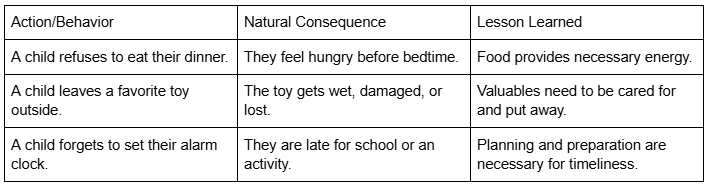
Natural consequences are the direct, inevitable results of a child's actions, with no parental intervention required. They are the universal laws of cause and effect applied to everyday life. They are inherently logical, fair, and, most importantly, they provide immediate and meaningful learning experiences.
Examples of Natural Consequences:
Why Natural Consequences Work Better
The effectiveness of this approach stems from its focus on internal motivation and real-world logic, rather than external control.
1. Focuses on the Behavior, Not the Child
When a parent imposes a punishment (e.g., "Go to your room for 15 minutes"), the child often focuses on the parent's anger or the unfairness of the punishment, rather than their own action. When a natural consequence occurs, the feedback loop is direct: "My action caused this unpleasant result." This reduces power struggles and minimizes feelings of resentment.
2. Teaches Responsibility and Problem-Solving
Natural consequences transform discipline from a moment of conflict into an opportunity for growth. The child must confront the direct outcome of their choice. If they break a toy because they threw it, they learn that toys are fragile, and they now face the problem of having a broken toy. The parent's role shifts from punisher to supportive guide, helping the child process the outcome and plan for next time.
3. Provides Immediate and Relevant Feedback
The connection between the action and the consequence is immediate and highly relevant, making the lesson stick. A child who misses their favorite TV show because they didn't finish their chores understands the linkage much more clearly than if the consequence was a remote, unrelated punishment several hours later.
Implementing Natural Consequences Effectively
While powerful, using natural consequences requires preparation, patience, and a thoughtful approach from the parent.
1. Safety First: When Not to Use Them
Natural consequences should never be used if the child's action poses a threat to their safety, the safety of others, or results in irreversible harm (e.g., running into the street, playing with fire, hitting a sibling). In these cases, immediate parental intervention and firm boundaries are essential.
2. Maintain Empathy and Neutrality
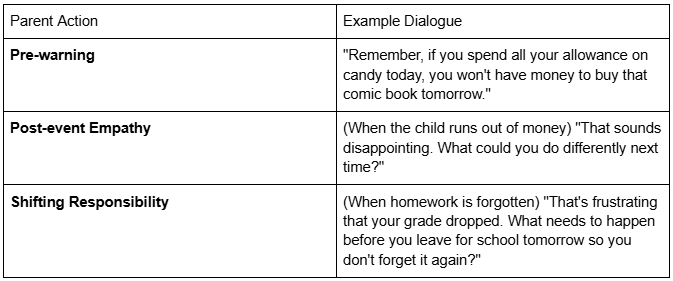
The power of the natural consequence is lost if the parent says, "I told you so!" or lectures the child. When the consequence occurs (e.g., they are cold because they refused to wear a coat), the parent should acknowledge the child's feeling without solving the problem for them: "I see you're feeling chilly. We talked about how cold it is outside." Offer comfort, but allow the discomfort of the consequence to remain the teacher.
3. Plan Ahead and Communicate
For certain predictable situations, it can be helpful to discuss the potential natural consequence before the action occurs. For example: "If you leave your bike unlocked, the natural consequence is that it might get stolen, and you won't have it to ride." This empowers the child to make an informed choice.
By embracing natural consequences, parents shift the focus from control to coaching. We equip our children with the internal compass needed to navigate the world, fostering genuine responsibility, resilience, and a deep understanding of how their choices shape their lives. It's not about making them suffer; it's about letting life be the most effective and unbiased teacher.